
cat beds In multi-cat households, even if all cats live under the same roof, vulnerable cats—such as introverted kittens, new additions, or older, frail cats—often find themselves at a disadvantage in the competition for resources. Frankly, this situation is quite common and can be improved with clever layout and arrangement. This article will focus on “dedicated resting areas” and “cat bed layouts” to help vulnerable cats find their own little space, reduce friction between cats, and enhance overall household well-being.
1. Why is resource competition more likely to occur in multi-cat households?
1. Cats’ social background
You might think domestic cats are naturally social creatures, but that’s not entirely true. Their ancestors, the African wildcat (Felis silvestris lybica), were essentially solitary hunters. Even in domestic environments, modern cats retain a keen sense of territory, core resting areas, and access to resources. In other words, every cat desires their own space and safe haven—even your usually clingy kitten needs his or her own private corner.
2. Problems caused by resource competition
Conflict is more likely to arise when cats live in close proximity or when resources (food bowls, water bowls, litter boxes, and resting areas) are insufficient or poorly distributed. Studies show that tension between cats in multi-cat households can range from 62% to 87%.
For example, one review noted that “inadequate or unevenly distributed resources can increase conflict between cats in a household.” The RSPCA even recommends a “number of cats plus one” rule: ideally, two cats should have three litter boxes, three food and water bowls, and three resting areas.
If resources are concentrated or passages are frequently occupied, vulnerable cats may think, “I can’t get in there at all!” or “I’m blocked again…” Over time, they are prone to stress, hiding, attacking, or retreating.
3. Vulnerable cats are more susceptible
In a multi-cat environment, if there is a cat that is dominant, large, young, or arrived first, it will usually take priority over high-quality resources. In contrast, a less privileged cat may:
- Fear of going to popular aisles or rest areas
- Avoiding certain litter boxes or resting areas, resorting to less-than-ideal locations
- Long-term exposure to suboptimal resources leads to accumulated stress, manifested as hiding, excessive grooming, decreased appetite, or behavioral withdrawal
Therefore, it is really important to provide vulnerable cats with safe, easily accessible resting corners with good visibility and smooth passages.
2. Exclusive rest corner: a small safe haven for vulnerable cats
1. Rest areas are also key resources
Many people overlook that a cat’s resting/sleeping area is actually one of their most important resources. Studies have shown that “quiet areas, observation areas, and hiding areas” are crucial to a cat’s well-being.
In a multi-cat household, if there is only one resting area or if there is intense competition, it can also become a focal point of conflict. A dedicated resting corner can help vulnerable cats:
- Have a stable, safe place where you won’t be disturbed by other cats
- Avoid anxiety caused by changing positions or interruptions to rest
- Regain a sense of control and security in one’s own “territory” and be more willing to relax
2. Cat beds: The core of the exclusive rest area
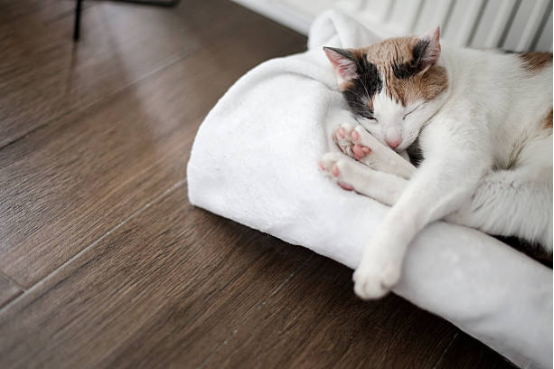
Cat beds aren’t just cushions; they serve as a psychological “home” for vulnerable cats. They’re most effective when placed in a high, quiet area where they can observe their surroundings but aren’t easily disturbed.
Customizing cat beds or adding shelters to create a resting area that feels like “my corner” can help vulnerable cats adapt more quickly. You’ll find they gradually develop a love for climbing up there, sometimes even taking long naps.
3. Avoid being squeezed out
Just like food bowls, litter boxes, and climbing frames, resting areas also need to be distributed in multiple locations. Research indicates that “conflicts between cats often stem from competition for important resources, including food, water, resting areas, and even litter boxes.”
If resting areas are neglected, vulnerable cats can easily be overtaken, unable to rest peacefully and experiencing chronic stress. Therefore, designating a dedicated resting area for your cat is essentially creating a psychological safety zone for it.
3. Operational Guidelines for Creating a Dedicated Rest Corner
Step 1: Assess the home environment and identify vulnerable cats
Observe which cats are always hiding in corners, blocked by obstacles, or have a poor appetite. Confirm whether the overall resources are distributed according to the “number of cats + 1” principle and whether vulnerable cats have smooth access routes.
Step 2: Select the resting angle position
It’s best to choose a relatively quiet area with limited access but still able to observe the surroundings. High platforms, windows, and corners against walls are all good options. Avoid popular areas, and ensure cat beds are easily accessible.
Step 3: Cat beds and environment layout
- Soft cushion and high edge, giving cats a sense of coverage
- You can use a hidden cat bed, a cave bed or place it on a cat climbing frame
- Add shielding around the cat so that it can temporarily hide from the sight of other cats
- Keep it exclusive and don’t let other cats use it frequently
- Provide exclusive toys, soft mats or small blankets to enhance the sense of belonging
Step 4: Enhance safe passages and visuals
Plan a “safe passage” from the vulnerable cat’s activity area to the resting corner to avoid passing through the dominant cat’s sight line. Place the resting area in a slightly elevated position or against the wall to minimize disturbance so that the cat can observe the environment and rest peacefully.
Step 5: Observe and adjust
Regularly monitor the less advantaged cats to see if they frequently use the resting corner, whether they are disturbed, and whether their rest quality improves. If the dominant cat still invades or the less advantaged cat refuses to use it, consider setting up a backup resting corner. Optimize the overall layout of food bowls, litter boxes, toys, and climbing structures to further reduce competition.
4. Benefits of a dedicated rest corner
For vulnerable cats
- Enhance your sense of security and don’t have to worry about being driven away at any time
- Reduce stress. Long-term low stress is good for health.
- Improved self-confidence, increased willingness to use resources and play, and reduce hiding
- Easier to interact with people and enhance the relationship between people and cats
For the entire cat population
- Reduce the possibility of conflict
- Make the environment more harmonious and each cat has its own controllable space
- Improve overall well-being, with more stable health and behavior
- It is also easier for the owner, reducing hiding and destructive or stressful behaviors
5. Common Misunderstandings and Precautions
- Misconception: Focusing on the food bowl or litter box and ignoring the rest area
- Misconception: Setting up resting corners in popular areas or places frequented by dominant cats
- Misconception: Just setting up a rest corner is enough
- Note: The resting angle should be re-evaluated when a new cat is added, when moving, or when there are changes in health.
- Note: Keep the rest area clean and stable so cats will be willing to use it.
VI. Conclusion
In multi-cat households, we can’t change a cat’s nature. However, by properly managing resources, providing dedicated resting areas, and creating a safe haven for vulnerable cats with cat beds, we can significantly improve their quality of life, reduce competition among cats, and foster greater family harmony. If you have a kitty who always hides in a corner, why not start today by creating a quiet, exclusive, and stress-free resting area for her so she too can feel the warmth of home?