
The days following surgery are always filled with heartache and anxiety. Cats, recovering from anesthesia, become cautious and even clumsy in their movements, often turning over. During these times, a suitable cat bed can be like a silent caregiver—it can help cats feel less pain, sleep more soundly, and bring peace of mind to their owners.
Many people think that “softness” is enough, but in fact, the support, shape, and material of a cat bed will directly affect wound recovery. Today’s article will take you through the perspective of postoperative care for cats and explain how to choose a cat bed that is truly suitable for the recovery period.
1. Why should the cat bed be “soft but not collapsing” after surgery?
1. Avoid pressure, friction and irritation on the wound
A cat’s skin and incisions are very delicate after surgery. Even tiny wrinkles and stitches in the mattress can cause discomfort. A bed that’s too hard can press directly against the wound, while a rough surface can cause friction and traction.
Veterinarians often recommend a “soft, clean bed”—one that’s soft but clean, distributes pressure, and resists dust accumulation. This allows the cat to rest with less external stimulation (as VCA Hospitals has noted).
2. Provide adequate support to prevent sinking
Some owners believe the softer the bed, the better. This isn’t true. A bed that’s too soft can cause a cat to sink into it, placing increased pressure on a specific area (perhaps near a surgical site) and even affecting blood circulation. The ideal bed is cushioned but not prone to collapse.
3. Help maintain body temperature and comfort
Cats often have low body temperatures after surgery, and a slightly enveloping bed can help. Soft edges and materials can retain warmth and prevent drafts, making your cat feel safe. On the other hand, if the bed is too cold, too flat, or exposed, your cat may constantly shift positions and sleep restlessly.
2. Softness Standards and Material Recommendations
This part is the “technical aspect,” but don’t worry; after reading it, you will be able to roughly determine what type to use for your cat.
| elements | Recommended Standards | Notes/Notes |
| Cushioning force | Medium to soft (with rebound) | It can both relieve pressure and support without collapsing |
| thickness | About 3–5 cm (adjusted according to body shape) | Too thin has no cushioning; too thick makes it unstable |
| Material | Memory foam, antibacterial sponge, high-density foam | Shape-retaining, moisture-proof, easy to clean |
| Covering | Removable and washable soft cloth (flannel/cotton) | Avoid rough friction on the wound |
| bottom layer | Non-slip or reinforced fabric | Prevent cat claws from moving the bed and causing pulling |
Tip: If you happen to have a memory foam mattress at home, you can temporarily lay a soft cotton blanket on it as a postoperative bed. As long as it is kept clean and flat, it can actually be very comfortable.
3. Shape design and structural considerations
Softness is one thing, but the “design logic” of a cat bed is equally crucial. The edges, height, and sense of coverage of a cat bed all affect a cat’s posture and sense of security.
1. Moderate edge height
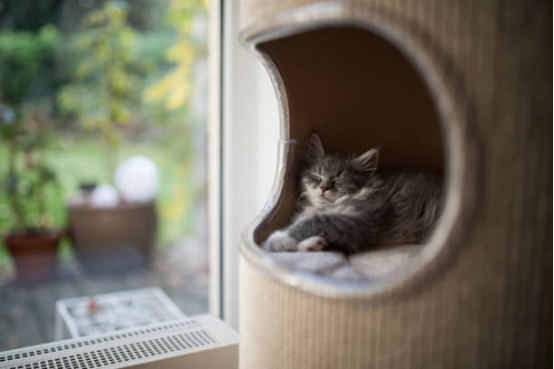
Avoid cat beds with high, doughnut-like sides. These are difficult for your cat to get in and out of after surgery, and even the slightest leg lift could cause the wound to be pulled. Choose a design with sides lower than shoulder height or a gentle slope.
2. Give it enough space to stretch
After surgery, their posture will be more rigid, and they may like to lie on their side or recline. The cat bed should be wide enough; otherwise, it may hit the edge when it moves.
3. Concave center + wrapping feeling
The slightly concave shape of the bed allows the body to be naturally fixed in the middle, without sliding or slipping. The “wrapped” feeling can also reduce postoperative anxiety.
4. Non-slip base is important
Cats are unstable after surgery, and a slippery bed can frighten them and even cause them to fall. Anti-slip fabric or a weighted base are small details for safety.
4. Special Considerations for Different Surgery Types
The requirements for cat beds vary depending on the postoperative location.
- Abdominal or soft tissue surgery: The bed surface should be flat, seamless, and without any tension lines. Otherwise, the cat may roll over and press on the wound.
- Hind legs or orthopedic surgery: The focus is on support. It should be able to distribute the pressure on the legs and should not be too high or too soft.
- Breast or back incisions: Allow the patient to turn over freely and avoid prolonged pressure on the same side. It is best to choose a bed material that can slightly adjust to deformation.
5. Tips for Home Arrangement and Usage
It is not enough to just choose a bed; where you put it and how you use it also matter.
Place the cat
away from doors, drafts, and noisy areas. Choose a quiet and warm corner where your cat can recover peacefully.
Limit jumping
: Don’t let your child get on high platforms after surgery! Temporarily remove any platforms or structures. Avoid any jumping during the recovery period.
Keeping it clean
is easy with its removable and washable design. Post-operatively, there will be a lot of exudate or hair loss, so it’s important to change and dry it regularly.
Observe
your cat’s reactions. If they frequently change positions, leave the bed, or lick specific areas, it could be a sign that the bed is too hard or at the wrong angle. Don’t hesitate to adjust it.
With the help of auxiliary tools,
You can put a low step next to the bed to make it easier for your cat to jump. Especially for cats wearing Elizabethan collars, it is important to ensure that the cat beds are spacious enough.
6. A short story
“My daughter Xiaohua had a cesarean section a while ago. For the first few days, she lay on the memory foam bed almost all day. I noticed that she would sometimes gently pick at the corner, as if she were uncomfortable. Later, I noticed that there was a small seam on the fabric over there. I replaced it with a smooth cotton blanket, and she completely settled down.”
Sometimes, it’s the tiny details—a line, a wrinkle—that make the difference between a cat’s sleep and its failure.
7. Conclusion: Let the recovery period be more gentle
After surgery, a cat’s world is actually very quiet. It won’t tell you “this hurts a little bit” or “that part is too hard,” but you can tell the answer from its movements, breathing, and posture.
At this stage, cat beds aren’t just a place to sleep; they’re a “healing zone” for your cat’s recovery. By choosing the right material, paying attention to softness and support, and adding a little human care, you can create the most gentle recovery space possible.